
The global demand for data centers is growing at an extraordinary pace. Cloud computing, artificial intelligence, and digital services are driving a wave of new infrastructure projects across Europe, North America, and Asia. Hyperscale operators are racing to bring new capacity online, placing increasing pressure on construction teams to deliver complex facilities faster than ever before.
Data center construction projects often involve mass concrete foundations, large structural slabs, and demanding construction schedules. Monitoring how concrete cures in these conditions is critical for preventing thermal cracking, verifying strength development, and ensuring structural quality.
While the digital technologies inside data centers continue to evolve rapidly, the buildings themselves rely heavily on one of the most widely used construction materials in the world: concrete.
For contractors delivering these mission-critical facilities, managing how concrete behaves during curing is essential. Large structural elements, tight project schedules, and strict reliability requirements mean that teams must closely monitor temperature, strength development, and curing performance.
This is where concrete monitoring technologies are becoming increasingly important. By providing real-time insight into the curing process, digital monitoring tools help contractors reduce risk, protect structural quality, and maintain demanding construction programmes.
Learn more about Data Center concrete monitoring technologies.
Data centers are not typical commercial buildings. They are designed to operate continuously and support critical digital infrastructure for decades. Because of this, construction standards are extremely high and schedules are often highly compressed.
Several factors make data center construction projects particularly demanding.
The rapid growth of digital services means that operators are under constant pressure to expand capacity. Construction teams are frequently required to deliver projects within extremely tight timeframes.
Many data centers require substantial foundations and floor slabs to support heavy equipment and infrastructure. These structural elements often involve large concrete pours, sometimes classified as mass concrete.
Major developers are building data centers in multiple regions at once, requiring consistent construction practices and reliable quality control across projects. These pressures create an environment where construction teams need accurate, real-time insight into concrete behaviour during curing.
Hyperscale data centers are among the fastest-growing segments of global construction. Major cloud providers are investing heavily in large-scale facilities designed to support massive computing capacity.
These projects often involve buildings covering tens of thousands of square metres and require extensive structural foundations and floor slabs. As a result, hyperscale data center construction frequently involves large concrete pours, which must be carefully managed during curing.
Because hyperscale facilities operate continuously and support critical digital infrastructure, contractors must ensure that structural elements meet strict quality and durability standards.
Monitoring concrete temperature and strength development helps construction teams maintain these standards while keeping fast-moving projects on schedule.
Concrete forms the structural backbone of most data center facilities. It is used in foundations, floor slabs, columns, and structural elements designed to support heavy equipment and infrastructure.
Many of these components involve large concrete pours, which generate heat as the cement hydrates. This heat can create temperature differences between the interior and exterior of the concrete structure.
If these temperature differentials become too large, they can lead to thermal cracking, potentially affecting durability and structural performance.
Managing temperature during the curing process is therefore critical, particularly for large or complex pours.
Without proper monitoring, construction teams may have limited visibility into what is happening inside the concrete as it cures.
Thermal cracking occurs when temperature differences within concrete create internal stresses that exceed the material's tensile strength.
This is particularly common in mass concrete pours, where the core of the concrete can remain significantly warmer than the surface during curing.
Several factors contribute to this risk:
If the temperature differential becomes too large, cracks may develop. While some cracks are cosmetic, others can affect durability and may require remediation.
For projects with strict quality standards—such as data center construction—avoiding these risks is essential.
Modern long range concrete monitoring systems provide real-time insight into curing conditions and strength development.
Fig 1: How Long Range Concrete Monitoring Sensors Provide Real-Time Data During Curing
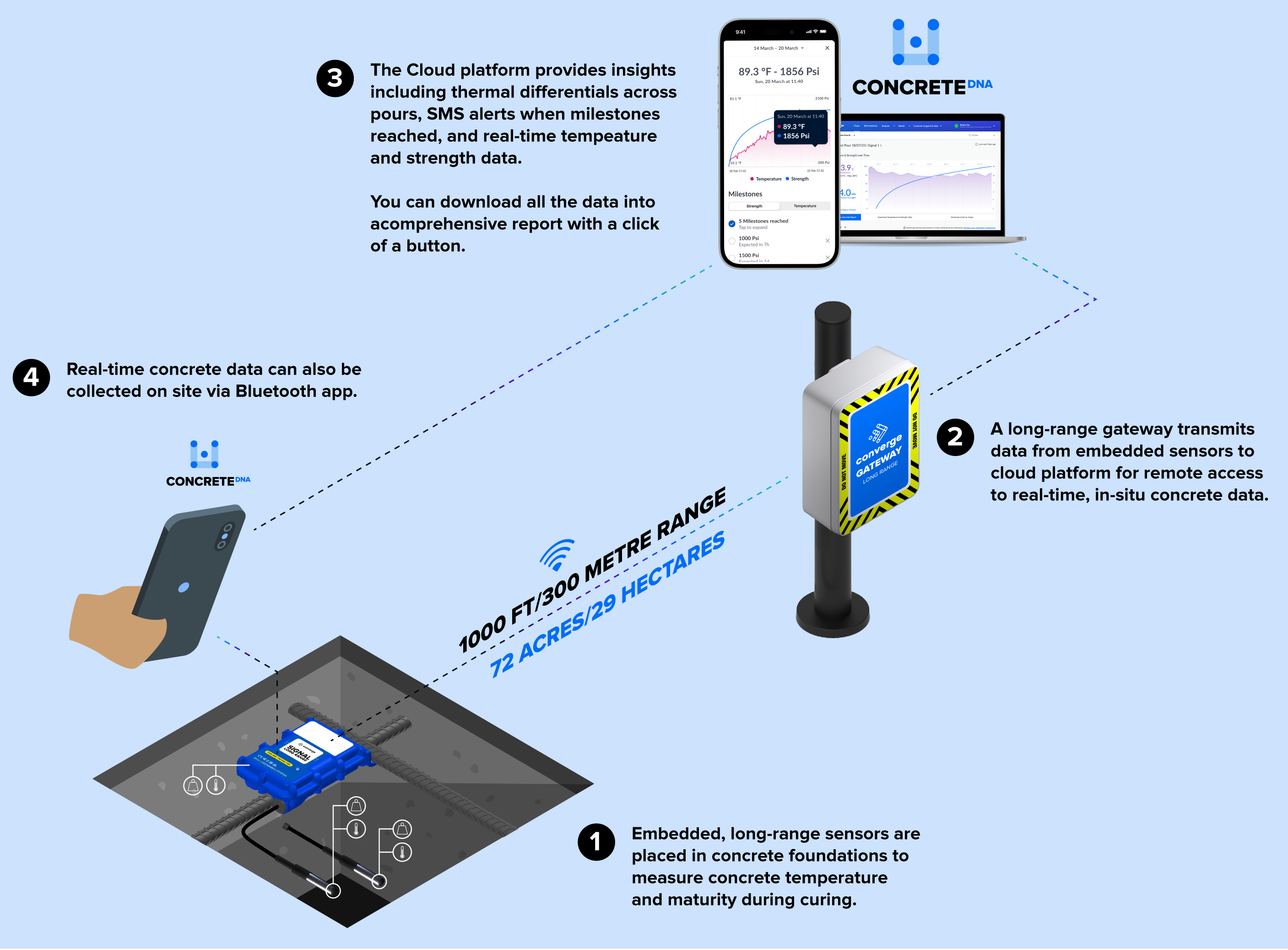
Sensors embedded within the concrete can measure key parameters such as:
This information allows project teams to better understand how the concrete is performing throughout the curing process.
With accurate monitoring data, contractors can:
Continuous temperature monitoring helps teams identify potential temperature gradients early and adjust curing strategies if needed.
Concrete maturity monitoring can help confirm when the concrete has achieved sufficient strength for subsequent construction activities.
Digital monitoring creates a clear record of curing conditions and performance, supporting quality documentation and compliance.
Instead of relying solely on estimates or manual measurements, teams can make informed decisions based on real-time data.
Construction schedules for data centers are often extremely tight. Any uncertainty around curing times can introduce delays and disrupt project timelines.
By using concrete curing monitoring systems, contractors can gain greater confidence in their construction schedule.
Monitoring technologies allow teams to:
For projects where speed and reliability are essential, this visibility can help maintain momentum and avoid costly delays.
The construction industry is increasingly embracing digital technologies to improve efficiency and reduce risk.
From Building Information Modelling (BIM) to connected sensors and cloud-based analytics, data is becoming a central part of modern construction management.
Concrete monitoring systems are an important part of this transformation.
By connecting sensors to digital platforms, project teams can access curing data in real time, whether they are on site or managing projects remotely.
These systems enable:
For complex infrastructure projects such as data centers, this level of visibility can significantly improve risk management.
Data centers are among the most demanding projects in modern construction. Their scale, complexity, and importance require careful management at every stage of the build.
Concrete monitoring technologies help construction teams meet these challenges by providing clear, reliable insight into how structural elements are curing and developing strength.
With better data, contractors can protect structural integrity, maintain construction schedules, and deliver high-performance facilities that meet the rigorous standards required for digital infrastructure.
Concrete monitoring helps construction teams track temperature and strength development during curing. This reduces the risk of thermal cracking, improves quality assurance, and helps contractors confirm when concrete is ready for the next stage of construction.
Mass concrete refers to large concrete pours where heat generated during curing can create temperature differences within the structure. If these temperature gradients become too large, thermal cracking may occur.
Concrete monitoring systems use embedded sensors to measure temperature and maturity within the structure. This data can be analysed to estimate strength development and ensure curing conditions remain within acceptable limits.
Learn more about Data Center Construction Monitoring with Converge
Download the Data Center Construction Concrete Monitoring guide
Offsite construction didn’t just move work away from site. Now, the people who know where each component is are spread across factories, suppliers and countries.

Hyperscale data centers are among the most complex projects in modern construction. This article explores the challenges contractors face when delivering large-scale facilities and how monitoring technologies help manage risk and maintain quality.
Large data center foundations often involve mass concrete pours that generate significant heat during curing. Learn why temperature monitoring is essential for preventing thermal cracking and ensuring structural reliability in data center construction.