
At Television Centre Phase 2, part of the redevelopment of the former BBC Television Centre in White City, Byrne Bros worked with Cevo Digital by Tarmac and ConcreteDNA to reduce embodied carbon while protecting programme across technically demanding concrete works, including post-tensioned slabs and slipform elements.
Reducing embodied carbon was a key project requirement, but programme-critical concrete elements presented a challenge.
Higher levels of GGBS could significantly reduce embodied carbon, but slower early-age strength development – particularly during winter – created uncertainty around post-tensioning and other programme-critical activities.
Traditional cube testing also meant the team often had to wait for laboratory results before making decisions. This encouraged a conservative approach to cement replacement to avoid putting the programme at risk.
Byrne Bros wanted to move beyond this trade-off: reduce embodied carbon without compromising programme certainty.
Byrne Bros implemented CEVO Digital to combine in-situ concrete monitoring, predictive mix modelling and concrete data management.
CURE provided continuous visibility into in-situ strength and temperature, allowing the team to make decisions based on actual concrete performance rather than relying solely on cube results.
Mix AI modelled the performance of lower-carbon mixes, helping the team understand how higher levels of cement replacement would affect early-age strength and programme.
Data Hub brought concrete quality, delivery and carbon records together, reducing the manual spreadsheets and records traditionally required for QA/QC and handover.
Implementation took less than six hours in a single session, allowing the project team to start using the system quickly.
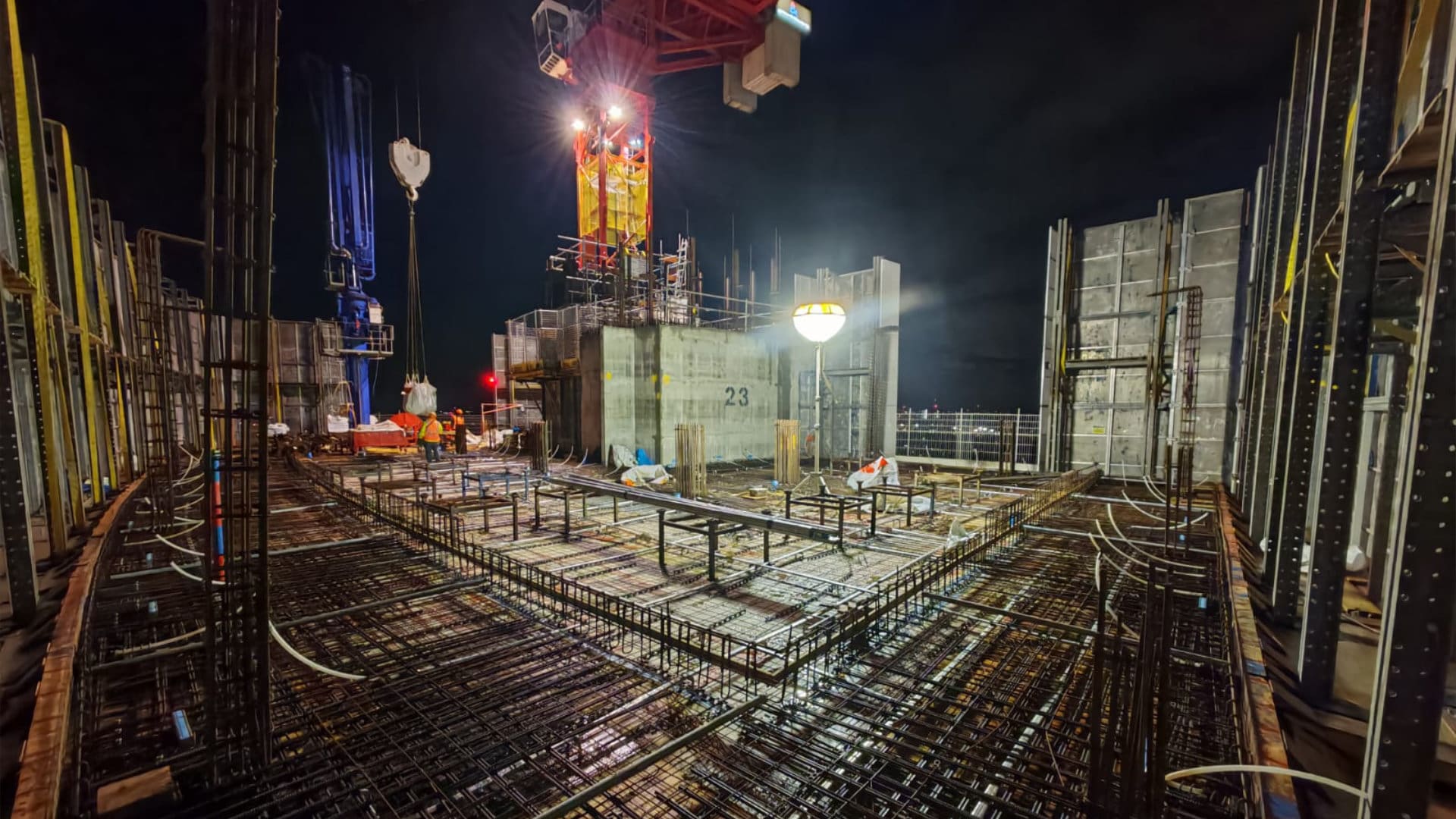
Together, CEVO Digital and ConcreteDNA gave Byrne Bros a more active way to manage concrete performance, programme and embodied carbon.